

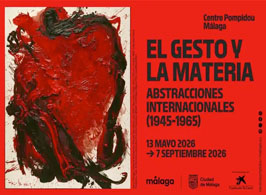
The exhibition “Gesture and Matter” at the Pompidou, Malaga, is dedicated to a significant moment in art history which, after the Second World War, saw the emergence in Paris of a new form of abstraction, no longer based on geometry, as had prevailed until then, but gestural and material-based. Influenced by the automatism championed by Surrealism, painters favored the spontaneity of gesture, often requiring considerable physical exertion, and invented novel methods of applying paint to the canvas.
In the 1940s and 1950s, the French capital served as a hub for artistic exchange, characterized by a dense network of galleries and a generation of art critics dedicated to fostering artists' collectives. Paris, which had once again become the center of the art world, attracted European artists, often driven from their countries by authoritarian regimes, as well as Americans, encouraged to settle in the capital thanks to the GI Bill, and numerous artists from Asia.
Intersecting various important movements in 20th-century art history, such as Art Informel, American Action Painting, and Gutai in Japan, the forty or so paintings (often large-format) in the exhibition "Gesture and Matter" are presented in five sections: "Art Autre" explores the notion of "informal" championed by critic Michel Tapié from 1950 onward. "Transatlantic Exchanges" evokes the relationship between the art scenes of Paris and New York. "Black is a Color" brings together artists who work exclusively with black, particularly highlighting the more or less controlled movements of the brush. “Asia/West” highlights the work of painters of Asian origin, inspired by this new aesthetic. In turn, Western artists demonstrate an equal affinity for calligraphy and Far Eastern spirituality. Finally, “A European Diffusion” reveals how gestural abstraction quickly became a common, widely shared language.
Curator: Christian Briend
assisted by Anne Foucault
HFA Artist Pages: